уторак, 27. март 2012.

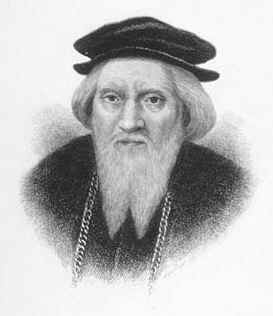
Captain John Smith (1579-1631)

New and successful attempt to make a settlement in Virginia; Captain John Smith.
- One of the leaders in the new expedition sent out to make a settlement in Virginia, while Raleigh was in prison, was Captain John Smith. He began life as a clerk in England. Not liking his work, he ran away and turned soldier. After many strange adventures, he was captured by the Turks and sold as a slave. His master, who was a Turk, riveted a heavy iron collar around his neck and set him to thrashing grain with a big wooden bat like a ball-club. One day the Turk rode up and struck his slave with his riding-whip. This was more than Smith could bear; he rushed at his master, and with one blow of his bat knocked his brains out. He then mounted the dead man's horse and escaped. After a time he got back to England; but as England seemed a little dull to Captain Smith, he resolved to join some emigrants who were going to Virginia.
What happened to Captain Smith on the voyage; the landing at Jamestown; what the settlers wanted to do; Smith's plan. — On the way to America, Smith was accused of plotting to murder the chief men among the settlers so that he might make himself "King of Virginia." The accusation was false, but he was put in irons and kept a prisoner for the rest of the voyage. In the spring of 1607 the emigrants reached Chesapeake Bay, and sailed up a river which they named the James in honor of King James of England; when they landed they named the settlement Jamestown for the same reason. Here they built a log fort, and placed three or four small cannon on its walls. Most of the men who settled Jamestown came hoping to find mines of gold in Virginia, or else a way through to the Pacific Ocean and to the Indies, which they thought could not be very far away. But Captain Smith wanted to help his countrymen to make homes here for themselves and their children.
Smith's trial and what came of it; how the settlers lived; the first English church; sickness; attempted desertion. — As soon as Captain Smith landed, he demanded to be tried by a jury of twelve men. The trial took place. It was the first English court and the first English jury that ever sat in America. The captain proved his innocence and was set free. His chief accuser was condemned to pay him a large sum of money for damages. Smith generously gave this money to help the settlement. As the weather was warm, the emigrants did not begin building log cabins at once, but slept on the ground, sheltered by boughs of trees. For a church they had an old tent, in which they met on Sunday. They were all members of the Church of England, or the Episcopal Church, and that tent was the first place of worship that we know of which was opened by Englishmen in America. When the hot weather came, many fell sick. Soon the whole settlement was like a hospital. Sometimes three or four would die in one night. Captain Smith, though not well himself, did everything he could for those who needed his help. When the sickness was over, some of the settlers were so discontented that they determined to seize the only vessel there was at Jamestown and go back to England. Captain Smith turned the cannon of the fort against them. The deserters saw that if they tried to leave the harbor he would knock their vessel to pieces, so they came back. One of the leaders of these men was tried and shot; the other was sent to England in disgrace.

Sir Walter Raleigh (1552-1618)


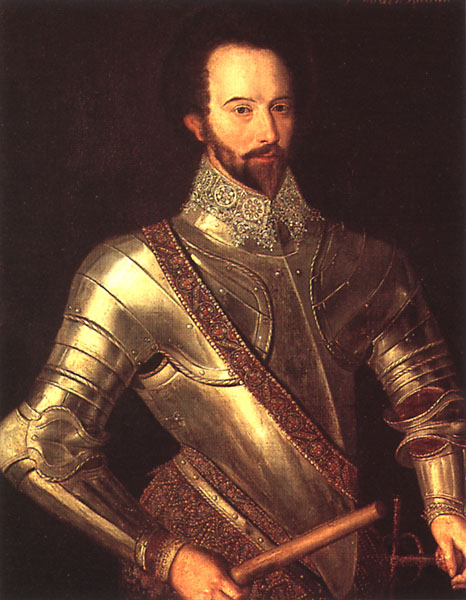
Sir Walter Raleigh (1552-1618)


Walter Raleigh sends two ships to America; how the Indians received the Englishmen.
- Although John Cabot discovered the continent of North America in 1497 and took possession of the land for the English, yet the English themselves did not try to settle here until nearly a hundred years later. Then (1584) a young man named Walter Raleigh, who was a great favorite of Queen Elizabeth's, sent out two ships to America. The captains of these vessels landed on Roanoke Island, on the coast of what is now the state of North Carolina. They found the island covered with tall red cedars and with vines thick with clusters of wild grapes. The Indians called this place the "Good Land." They were pleased to see the Englishmen, and they invited them to a great feast of roast turkey, venison, melons, and nuts.
Queen Elizabeth names the country Virginia; first settlers; what they sent Walter Raleigh. — When the two captains returned to England, Queen Elizabeth—the "Virgin Queen," as she was called—was delighted with what she heard of the "Good Land." She named it Virginia in honor of herself. She also gave Raleigh a title of honor. From that time he was no longer called plain Walter Raleigh or Mr. Raleigh, but Sir Walter Raleigh. Sir Walter now (1585) shipped over emigrants to settle in Virginia. They sent back to him as a present two famous American plants—one called Tobacco, the other the Potato. The queen had given Sir Walter a fine estate in Ireland, and he set out both the plants in his garden. The tobacco plant did not grow very well there, but the potato did; and after a time thousands of farmers began to raise that vegetable, not only in Ireland, but in England too. As far back then as that time—or more than three hundred years ago—America was beginning to feed the people of the Old World.
The Virginia settlement destroyed. — Sir Walter spent immense sums of money on his settlement in Virginia, but it did not succeed. One of the settlers, named Dare, had a daughter born there. He named her Virginia Dare. She was the first English child born in America. But the little girl, with her father and mother and all the rest of the settlers, disappeared. It is supposed that they were either killed by the Indians or that they wandered away and starved to death; but all that we really know is that not one of them.

понедељак, 26. март 2012.

Ponce De Leon, Balboa, Soto (Period of Discovery, 1513-1542)

The magic fountain; Ponce de Leon discovers Florida; Balboa discovers the Pacific Ocean.
- The Indians on the West India Islands believed that there was a wonderful fountain in a land to the west of them. They said that if an old man should bathe in its waters, they would make him a boy again. Ponce de Leon, a Spanish soldier who was getting gray and wrinkled, set out to find this magic fountain, for he thought that there was more fun in being a boy than in growing old. He did not find the fountain, and so his hair grew grayer than ever and his wrinkles grew deeper. But in 1513 he discovered a land bright with flowers, which he named Florida. He took possession of it for Spain. The same year another Spaniard, named Balboa, set out to explore the Isthmus of Panama. One day he climbed to the top of a very high hill, and discovered that vast ocean—the greatest of all the oceans of the globe—which we call the Pacific.
De Soto discovers the Mississippi. — Long after Balboa and Ponce de Leon were dead, a Spaniard named De Soto landed in Florida and marched through the country in search of gold mines. In the course of his long and weary wanderings, he came to a river more than a mile across. The Indians told him it was the Mississippi, or the Great River. In discovering it, De Soto had found the largest river in North America; he had also found his own grave, for he died shortly after, and was secretly buried at midnight in its muddy waters.
The Spaniards build St. Augustine; we buy Florida in 1819.—More than twenty years after the burial of De Soto, a Spanish soldier named Menendez went to Florida and built a fort on the eastern coast. This was in 1565. The fort became the centre of a settlement named St. Augustine. It is the oldest city built by white men, not only in what is now the United States, but in all North America. In 1819, or more than two hundred and fifty years after St. Augustine was begun, Spain sold Florida to the United States.

John Cabot (1472-1498)

John Cabot discovers the continent of North America
- At the time that Columbus set out on his first voyage across the Atlantic in 1492, John Cabot, an Italian merchant, was living in the city of Bristol, England. When the news reached that city that Columbus had discovered the West Indies, Cabot begged Henry the Seventh, king of England, to let him see if he could not find a shorter way to the Indies than that of Columbus. The king gave his consent, and in the spring of 1497 John Cabot, with his son Sebastian, who seems to have been born in Bristol, sailed from that port. They headed their vessels toward the northwest; by going in that direction they hoped to get to those parts of Asia and the Spice Islands which were known to Europe, and which Columbus had failed to reach. Early one bright morning toward the last of June, 1497, they saw land in the west. It was probably Cape Breton Island, a part of Nova Scotia. John Cabot named it "The Land First Seen." Up to this time Columbus had discovered nothing but the West India Islands, but John Cabot now saw the continent of North America; no civilized man had ever seen it before. There it lay, a great, lonely land, shaggy with forests, with not a house or a human being in sight.
John Cabot takes possession of the country for the king of England.— Cabot went on shore with his son and some of his crew. In the vast, silent wilderness they set up a large cross. Near to it they planted two flag-poles, and hoisted the English flag on one and the flag of Venice, the city where John Cabot had lived in Italy, on the other. Then they took possession of the land for Henry the Seventh. It was in this way that the English came to consider that the eastern coast of North America was their property, although they did not begin to make settlements here until nearly a hundred years later.
John Cabot and his son return to Bristol. — After sailing about the Gulf of St. Lawrence without finding the passage through to Asia for which they were looking, the voyagers returned to England. The king was so pleased with what John Cabot had discovered that he made him a handsome present; and when the captain, richly dressed in silk, appeared in the street, the people of Bristol would "run after him like mad" and hurrah for the "Great Admiral," as they called him.
What the Cabots carried back to England from America.—The Cabots carried back to England some Indian traps for catching game and perhaps some wild turkeys—an American bird the English had then never seen, but whose acquaintance they were not sorry to make. They also carried over the rib of a whale which they had found on the beach in Nova Scotia. Near where the Cabots probably lived in Bristol there is a famous old church. It was built long before the discovery of America, and Queen Elizabeth said that it was the most beautiful building of its kind in all England. In that church hangs the rib of a whale. It is believed to be the one the Cabots brought home with them. It reminds all who see it of that voyage in 1497 by which England got possession of a very large part of the continent of North America.

Christopher Columbus

Birth and boyhood of Columbus.
- Christopher Columbus, the discoverer of America, was born at Genoa, a seaport of Italy, more than four hundred and fifty years ago. His father was a wool-comber. Christopher did not care to learn that trade, but wanted to become a sailor. Seeing the boy's strong liking for the sea, his father sent him to a school where he could learn geography, map-drawing, and whatever else might help him to become some day commander of a vessel.
Columbus becomes a sailor — When he was fourteen Columbus went to sea. In those days the Mediterranean Sea swarmed with war-ships and pirates. Every sailor, no matter if he was but a boy, had to stand ready to fight his way from port to port. In this exciting life, full of adventure and of danger, Columbus grew to manhood. The rough experiences he then had did much toward making him the brave, determined captain and explorer that he afterwards became.
Columbus has a sea-fight; he goes to Lisbon. — According to some accounts, Columbus once had a desperate battle with a vessel off the coast of Portugal. The fight lasted, it is said, all day. At length both vessels were found to be on fire. Columbus jumped from his blazing ship into the sea, and catching hold of a floating oar, managed, with its help, to swim to the shore, about six miles away.He then went to the port of Lisbon. There he married the daughter of a famous sea-captain. For a long time after his marriage Columbus earned his living partly by drawing maps, which he sold to commanders of vessels visiting Lisbon, and partly by making voyages to Africa, Iceland, and other countries.
What men then knew about the world. — The maps which Columbus made and sold were very different from those we now have. At that time not half of the world had been discovered. Europe, Asia, and a small part of Africa were the chief countries known. The maps of Columbus may have shown the earth shaped like a ball, but he supposed it to be much smaller than it really is. No one then had sailed round the globe. No one then knew what lands lay west of the broad Atlantic; for this reason we should look in vain, on one of the maps drawn by Columbus, for the great continents of North and South America or for Australia or the Pacific Ocean.
The plan of Columbus for reaching the Indies by sailing west. — While living in Lisbon, Columbus made up his mind to try to do what no other man, at that time, dared attempt,—that was to cross the Atlantic Ocean. He thought that by doing so he could get directly to Asia and the Indies, which, he believed, were opposite Portugal and Spain. If successful, he could open up a very profitable trade with the rich countries of the East, from which spices, drugs, and silk were brought to Europe. The people of Europe could not reach those countries directly by ships, because they had not then found their way round the southern point of Africa.
Columbus tries to get help in carrying out his plans. — Columbus was too poor to fit out even a single ship to undertake such a voyage as he had planned. He asked the king of Portugal to furnish some money or vessels toward it, but he received no encouragement. At length he determined to go to Spain and see if he could get help there.On the southern coast of Spain there is a small port named Palos. Within sight of the village of Palos, and also within plain sight of the ocean, there was a convent,—which is still standing,—called the Convent of Saint Mary.One morning a tall, fine-looking man, leading a little boy by the hand, knocked at the door of this convent and begged for a piece of bread and a cup of water for the child. The man was Columbus,—whose wife was now dead,—and the boy was his son.It chanced that the guardian of the convent noticed Columbus standing at the door. He liked his appearance, and coming up, began to talk with him. Columbus frankly told him what he was trying to do. The guardian of the convent listened with great interest; then he gave him a letter to a friend who he thought would help him to lay his plans before Ferdinand and Isabella, the king and queen of Spain.

Introduction of American history

Introduction

Our object is to present clearly and accurately those facts and principles in the lives of some of the chief founders and builders of America which would be of interest and value to pupils beginning the study of American history, but also to the people who what to refresh their knowledge about this continent. Through our web site great care has been taken to relate only such incidents and anecdotes as are believed to rest on unexceptionable authority.
Enjoy your visit
The history of the United States traditionally starts with the Declaration of Independence in the year 1776, yet its territory was occupied first by the Native Americans since prehistoric times and then also by European colonists who followed the voyages of Christopher Columbus starting in 1492. The largest settlements were by the English on the East Coast, starting in 1607. By the 1770s the Thirteen Colonies contained two and half million people, were prosperous, and had developed their own political and legal systems. The British government's threat to American self-government led to war in 1775 and the Declaration of Independence in 1776. With major military and financial support from France, the patriots won the American Revolution. In 1789 the Constitution became the basis for the United States federal government, with war hero George Washington as the first president. The young nation continued to struggle with the scope of central government and with European influence, creating the first political parties in the 1790s, and fighting a second war for independence in 1812.
U.S. territory expanded westward across the continent, brushing aside Native Americans and Mexico, and overcoming modernizers who wanted to deepen the economy rather than expand the geography. Slavery of Africans was abolished in the North, but heavy world demand for cotton let it flourish in the Southern states. The 1860 election of Abraham Lincoln calling for no more expansion of slavery triggered a crisis as eleven slave states seceded to found the Confederate States of America in 1861. The bloody American Civil War (1861–65) redefined the nation and remains the central iconic event. The South was defeated and, in the Reconstruction era, the U.S. ended slavery, extended rights to African Americans, and readmitted secessionist states with loyal governments. The national government was much stronger, and it now had the explicit duty to protect individuals. The present 48 contiguous states were admitted by early 1912, with Alaska and Hawaii added in 1959.
Thanks to an outburst of entrepreneurship in the North and the arrival of millions of immigrant workers from Europe, the U.S. became the leading industrialized power by the early 20th century. Disgust with corruption, waste, and traditional politics stimulated the Progressive movement, 1890s-1920s, which pushed for reform in industry and politics and put into the Constitution women's suffrage and Prohibition of alcohol (the latter repealed in 1933). Initially neutral in World War I, the U.S. declared war on Germany in 1917, and funded the Allied victory. The nation refused to follow President Woodrow Wilson's leadership and never joined the League of Nations. After a prosperous decade in the 1920s the Wall Street Crash of 1929 marked the onset of the a decade-long world-wide Great Depression. A political realignment expelled the Republicans from power and installed Democrat Franklin D. Roosevelt and his elaborate and expensive New Deal programs for relief, recovery, and reform. Roosevelt's Democratic coalition, comprising ethics in the north, labor unions, big-city machines, intellectuals, and the white South, dominated national politics into the 1960s. After the Japanese attack on Pearl Harbor in December 1941, the U.S. entered World War II alongside the Allies and helped defeat Nazi Germany in Europe and, with the detonation of newly-invented atomic bombs, Japan in Asia and the Pacific.